A guide to what's up in the sky for Southern Australia
Starwatch for October 2026 - Sat 3rd Oct 2026
Published 3rd Oct 2026
Astronauts, looking out of the space station windows at night, see great clusters of lights; the glow of hundreds of thousands of individual lights that mark cities on earth.
M15—Globular Cluster in Pegasus - Fri 2nd Oct 2026
Published 2nd Oct 2026
Messier 15 or M15 is a globular cluster in the constellation Pegasus. It was included in Charles Messier's catalogue of comet-like objects in 1764
Starwatch for September 2026 - Mon 7th Sep 2026
Published 7th Sep 2026
Spring is just around the corner, and with it, comes the promise of warmer evenings and clearer skies. And hopefully the opportunity to spend more time looking up!
Globular Cluster NGC 104 - Sun 6th Sep 2026
Published 6th Sep 2026
Globular Cluster NGC 104 - Located in the far southern constellation of Tucana
Starwatch for August 2026 - Sun 2nd Aug 2026
Published 2nd Aug 2026
The mid-winter Milky Way is still high overhead, and stars like Vega, Altair and Fomalhaut help to light the way on these cold nights. They will soon give way to the spring stars and constellations. Like our Sun, these stars are what astronomers refer to as Population I stars. Let’s explain that.
Colliding Galaxies in Ara - Sat 1st Aug 2026
Published 1st Aug 2026
ESO138-29 - Colliding Galaxies in Ara Right Ascension: 17:29:12 Declination: -62:27:35
Starwatch for July 2026 - Sat 27th Jun 2026
Published 27th Jun 2026
The centre of our galaxy, the Milky Way, is directly overhead during these cold winter evenings, and it is here, that we find one of the most prominent constellations.
M57—The Ring Nebula in Lyra - Fri 26th Jun 2026
Published 26th Jun 2026
The Ring Nebula, M57, is a planetary nebula in the northern constellation of Lyra
Starwatch for June 2026 - Mon 1st Jun 2026
Published 1st Jun 2026
The winter Milky Way shines across the sky from east to west in a blaze of starlight.
The Lagoon Nebula - Sat 30th May 2026
Published 30th May 2026
Image—The VLT Survey Telescope at ESO's Paranal Observatory in Chile
Starwatch for May 2026 - Sat 2nd May 2026
Published 2nd May 2026
The dominant constellation in our evening sky during autumn and winter is Scorpius, currently shining brightly in the eastern sky. Its brightest star, Antares, is a huge star of gargantuan proportions.
M83 - Spiral Galaxy in Hydra - Fri 1st May 2026
Published 1st May 2026
Messier 83 or M83 is a barred spiral galaxy approximately 15 million light-years away in the constellation borders of Hydra and Centaurus.
Starwatch for April 2026 - Tue 31st Mar 2026
Published 31st Mar 2026
As you venture out these crisp autumn evenings for a look at the night sky, bid a fond farewell to our starry companions over summer, and welcome the stars that will become our friends during the frosty winter evenings ahead. Stars with names like Arcturus, Antares, Spica, and Regulus.
NGC 1566 - Mon 30th Mar 2026
Published 30th Mar 2026
Spiral Galaxy in Dorado NGC 1566 is a spiral galaxy in the southern constellation of Dorado, the swordfish. It was discovered on May 28, 1826, by Scottish astronomer James Dunlop, observing from Paramatta Observatory in New South Wales. At 10th magnitude, it requires a telescope to view it.
Starwatch for March 2026 - Fri 27th Feb 2026
Published 27th Feb 2026
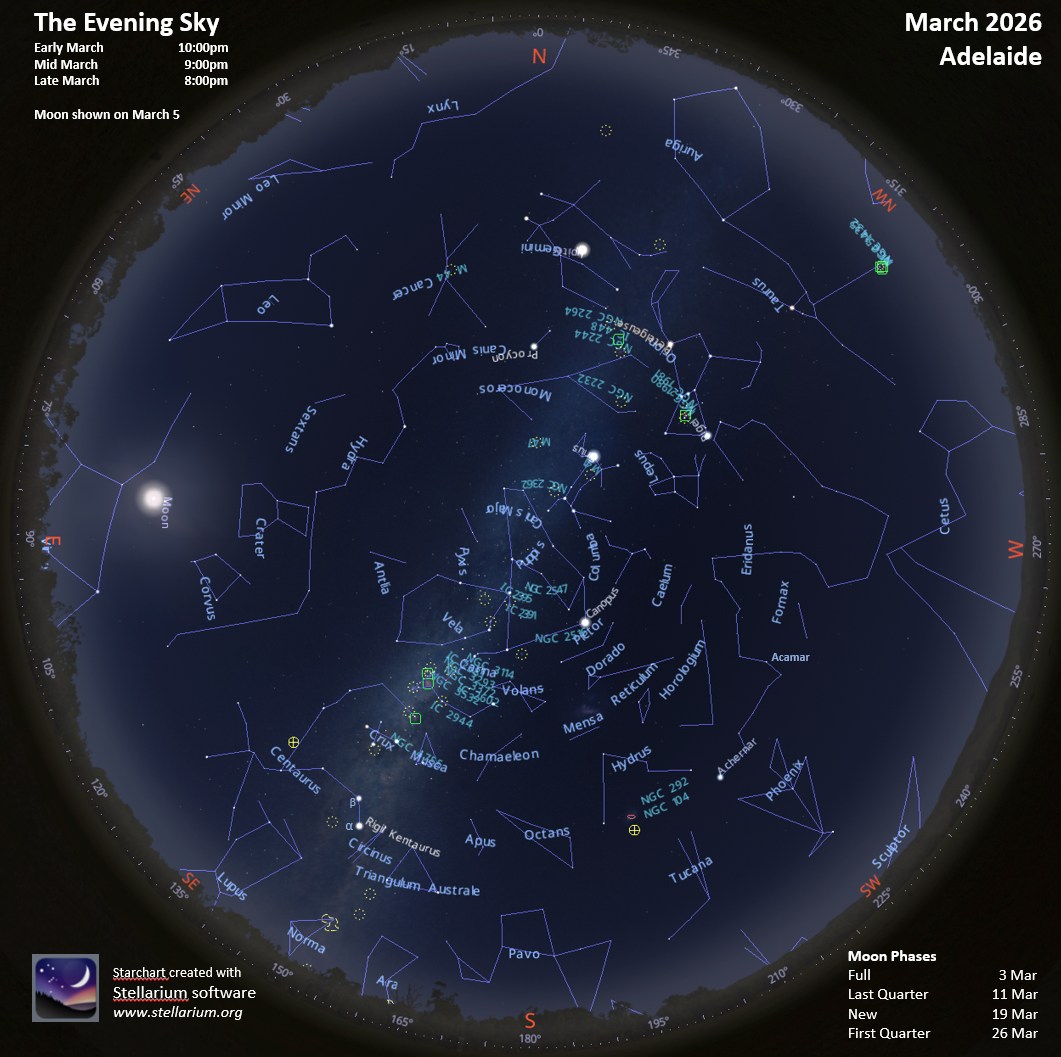
It seems just like yesterday that we greeted the return of the summer stars to the evening sky, and here we are in March, getting ready to wave goodbye!!
M44—The Beehive Cluster - Wed 25th Feb 2026
Published 25th Feb 2026
The Beehive Cluster is an open cluster in the constellation Cancer.
Starwatch for February 2026 - Mon 2nd Feb 2026
Published 2nd Feb 2026
During these warm February evenings, the summer Milky Way is visible directly overhead, running north-south across the sky. The evening sky is resplendent with many brilliant stars. From Capella in the north to the Pointers in the south, the sky is a sheer delight to explore.
NGC 2439—Open Star Cluster - Sun 1st Feb 2026
Published 1st Feb 2026
NGC 2439—Open Star Cluster - Distance: 12,500 light years
Starwatch for January 2026 - Tue 30th Dec 2025
Published 30th Dec 2025
We can think of our location in the universe along the lines of an address. The street would be planet Earth, the local government area would be the solar system, and the country would be the Milky Way Galaxy.
M1 - the Crab Nebula - Mon 29th Dec 2025
Published 29th Dec 2025
Distance: 6,500 light years
Starwatch for December 2025 - Tue 25th Nov 2025
Published 25th Nov 2025
All the stars we see in the night sky belong to our Milky Way galaxy. However, there are some objects outside of the Milky Way galaxy that can be seen quite clearly with no or little optical power.
Starwatch for November 2025 - Wed 29th Oct 2025
Published 29th Oct 2025
A 101 years ago, on November 23, 1924, the universe got larger.
Starwatch for October 2025 - Thu 2nd Oct 2025
Published 2nd Oct 2025
Astronomical distances can be mind boggling. Our closest neighbour, the Moon, is 380,000 kms away — equal to about 10 trips around Earth’s equator.
Starwatch for September 2025 - Wed 3rd Sep 2025
Published 3rd Sep 2025
A few lingering stars of winter are still in view during the evening. Antares, Altair, Vega have lit up the cold winter nights for us. But there is really only one bright star that puts in its best showing during these early spring nights:
NGC 7293 – The Helix Nebula - Tue 2nd Sep 2025
Published 2nd Sep 2025
Image © Patrick Cosgrove. The Helix Nebula, also known as NGC 7293, is a planetary nebula (PN) located in the constellation Aquarius.
Starwatch for August 2025 - Sun 3rd Aug 2025
Published 3rd Aug 2025
Imagine yourself sitting on a rock on the dark side of Moon, gazing up at the Milky Way. There's no stray lights, no atmosphere to dull your view of the night sky. The stars are so brilliant, so big, you could reach out and touch them.
NGC 4755 - Fri 1st Aug 2025
Published 1st Aug 2025
The Jewel Box Star Cluster. Image © Sergio Equivar, Buenos Aires, Argentina
Starwatch for July 2025 - Thu 3rd Jul 2025
Published 3rd Jul 2025
Look up overhead on any of these frosty winter’s nights, and if you have a dark area away from direct lighting, you’ll see the Milky Way shining brightly.
Galaxy NGC 6744 in Pavo - Wed 2nd Jul 2025
Published 2nd Jul 2025
This is NGC 6744, a spiral galaxy bearing similarities to our home galaxy, the Milky Way.
Starwatch for June 2025 - Mon 2nd Jun 2025
Published 2nd Jun 2025
The winter Milky Way shines across the sky from east to west in a blaze of starlight.
Eta Carinae Nebula (NGC 3372) - Sun 1st Jun 2025
Published 1st Jun 2025
Eta Carinae Nebula (NGC 3372) Distance: 7500 Light Years
Starwatch for May 2025 - Wed 30th Apr 2025
Published 30th Apr 2025
We have recently seen the destructive power of extreme weather events, such as cyclones and the flooding in southwest Queensland. It left in its wake flooded businesses, broken roads, power outages, and other problems. The repair bill will run into billions of dollars.
NGC 5139 - Omega Centauri - Tue 29th Apr 2025
Published 29th Apr 2025
Globular Cluster in Centaurus
Starwatch for April 2025 - Wed 2nd Apr 2025
Published 2nd Apr 2025
The crisp autumn evenings of April offer an ideal opportunity to explore the majesty of the southern sky. Go find yourself a nice dark spot in the back-garden, and let your eyes become accustomed to the darkness. Notice how many more stars you can see, even after a few minutes, as the pupils of your eyes expand to let as much light in as possible.
IC434 -The Horsehead Nebula - Tue 1st Apr 2025
Published 1st Apr 2025
Distance: 1500 Light Years |Constellation - Orion
Starwatch - March 2025 - Mon 3rd Mar 2025
Published 3rd Mar 2025
There's nothing more magical than to lie down on your back lawn on a warm summer evening and gaze up at the brilliant night sky.
Eta Carinae Nebula (NGC 3372) - Sat 1st Mar 2025
Published 1st Mar 2025
Distance: 7500 Light Years
Starwatch - February 2025 - Wed 5th Feb 2025
Published 5th Feb 2025
Two bright beacons hold centre stage in our night sky during February. In the beautiful pastel hues of an Australian summer sunset.
M104 - The Sombrero Galaxy - Tue 4th Feb 2025
Published 4th Feb 2025
Distance: 31 Million Light Years
Starwatch - January 2025 - Wed 1st Jan 2025
Published 1st Jan 2025
There's nothing more magical than to lie down on your back lawn on a warm summer evening and gaze up at the brilliant night sky.
The Pleiades star cluster - Tue 31st Dec 2024
Published 31st Dec 2024
The Pleiades star cluster (The Seven Sisters) Distance: 435 Light Years
Starwatch - December 2024 - Sun 1st Dec 2024
Published 1st Dec 2024
The stars that shine at night do so from immense distances.
Starwatch - November 2024 - Mon 4th Nov 2024
Published 4th Nov 2024
We recently saw the destructive power of hurricanes Milton and Helene, as they cut a path of destruction through various states in the US. They left in their wake flooded businesses, broken roads, power outages, and other problems. The repair bill will run into billions of dollars.
Large Magellanic Cloud - Fri 1st Nov 2024
Published 1st Nov 2024
Distance: 163,000 light years Right Ascension 05 : 23.6 Declination -69 : 45
Starwatch - October 2024 - Mon 30th Sep 2024
Published 30th Sep 2024
After a spectacular encounter with Pluto back in July 2015, the New Horizons spacecraft was redirected to visit a more distant object, known as 2014 MU69.
OCTOBER’S DEEP SKY HIGHLIGHT - Sun 29th Sep 2024
Published 29th Sep 2024
M31—The Andromeda Galaxy Distance: 2.5 million Light Years
Starwatch - September 2024 - Sat 31st Aug 2024
Published 31st Aug 2024
Spring is just around the corner, and with it, comes the promise of warmer evenings and clearer skies. And hopefully the opportunity to spend more time looking up!
NGC 253 – Galaxy in Sculptor - Fri 30th Aug 2024
Published 30th Aug 2024
NGC 253 is the brightest member of the Sculptor Group of galaxies.
Starwatch - August 2024 - Tue 30th Jul 2024
Published 30th Jul 2024
f you're brave enough to venture outside these cold winter nights, you'll be greeted by the heart of our Milky Way galaxy directly overhead. Find yourself a dark space in your backyard on a clear moonless night, and look straight up.
The Swan Nebula - Mon 29th Jul 2024
Published 29th Jul 2024
M17 – The Swan Nebula in Sagittarius
Starwatch July 2024 - Mon 8th Jul 2024
Published 8th Jul 2024
Look up overhead on any of these frosty winter’s nights, and as long as you have a dark area away from direct lighting, you’ll see the band of the Milky Way shining brightly.
Merging Galaxies - Sun 7th Jul 2024
Published 7th Jul 2024
NGC 4038-4039 Merging Galaxies - The Antennae. Distance: 45 million Light Years.
Starwatch June 2024 - Sun 2nd Jun 2024
Published 2nd Jun 2024
About half-way up the northern evening sky, a bright star shines.
The Trifid Nebula - Sat 1st Jun 2024
Published 1st Jun 2024
M20 – The Trifid Nebula in Sagittarius
Starwatch May 2024 - Thu 2nd May 2024
Published 2nd May 2024
A myriad of bright stars adorn the late autumn evening sky.
Galaxy NGC 5128 - Wed 1st May 2024
Published 1st May 2024
Galaxy NGC 5128—Centaurus A
Comet Pons-Brooks - Wed 10th Apr 2024
Published 10th Apr 2024
Looking west on the evening of April 27., 30 minutes after sunset. Locate the orange star Aldebaran, then scan to the left until you come to a fuzzy spot in the sky. Train your binoculars on it, the comet will be 239 million kilometres away. Graphic generated with Stellarium planetarium software.
M104 - The Sombrero Galaxy - Tue 9th Apr 2024
Published 9th Apr 2024
M104 - The Sombrero Galaxy. Distance: 31 Million Light Years
Starwatch - April 2024 - Mon 8th Apr 2024
Published 9th Apr 2024
Some of the brightest stars in the whole sky can be seen during these crisp autumn evenings.
Starwatch - March 2024 - Wed 6th Mar 2024
Published 6th Mar 2024
What a wonderful time of the year this is to be observing the night sky. The weather is warm, the nights clear, and the Milky Way shines directly overhead!
Object of the Month - Mon 4th Mar 2024
Published 4th Mar 2024
Eta Carinae Nebula (NGC 3372)
Distance: 7500 Light Years
Right Ascension: 10 : 43.8 | Declination: -59 : 52

It seems just like yesterday that we greeted the return of the summer stars to the evening sky, and here we are in March, getting ready to wave goodbye!!
So, let’s introduce some of the Autumn stars and constellations. The Milky Way stretches from the northwest to the southeast, crossing directly overhead. In the southeast, Crux, the Southern Cross, is very conspicuous. The two Pointers, Alpha (α) and Beta (β) Centauri can be found immediately below it. They are known as the Pointers because, as the Southern Cross and the Pointers rotate around the South Celestial Pole, they always point to the Southern Cross.
Alpha Centauri, the lower and brighter of the two Pointers, is actually one of the closest stars to our Sun, at a distance of only 4.25 light years. It is also one of the most spectacular sights in the sky when viewed through a telescope. Alpha Centauri really consists of two stars which are almost identical twins of our own Sun, and a third star, Proxima Centauri, that orbits around the common centre of gravity on a journey that takes several million years. The two main stars revolve around each other every 80 years.
Beta Centauri looks only slightly fainter than Alpha Centauri, so that the logical conclusion would be that it must be at about the same distance from us as Alpha Centauri. Wrong! Beta is a much brighter star that is over 200 times further away.
Prominent in the northeast is the constellation of Leo, the Lion. A pattern of stars that looks like an upside-down question mark forms Leo's head and mane. The bright blue-white star at the top of this pattern is Regulus, the lion's heart.
Looking to the west from Regulus, looms Cancer, one of the faintest constellations in the sky. As if to make up for its lacklustre showing of individual stars, Cancer sports a beautiful star cluster. From a dark spot, making sure there’s no moonlight, scan the night sky right in the middle of Cancer. What the eyes alone see as a faint blur, binoculars pick up as a sparkling scattering of gems: the Beehive star cluster (M44).
The constellation of Eridanus, the river, is high in the western sky as night falls. It begins near Rigel, the bright star at the foot of Orion. It then makes as many twists and turns as most earthly rivers before reaching its first “end,” Acamar. After that, it keeps going until it reaches the final end, Achernar. And both star names mean “the end of the river.”
In fact, that’s exactly why Eridanus has two end-points. From the latitudes of ancient Greece, where the constellation was drawn, skywatchers could see only down to Acamar; everything else remained below the horizon. So, Eridanus ended right there.
Centuries later, though, European ships sailed into the southern hemisphere. Crew members saw a much brighter star down to the lower left of Acamar, so they added it to the outline of Eridanus. And they gave it a nearly identical name, Achernar, giving the river a brighter end.
With the coming of Autumn, we bid farewell to the Pleiades star cluster, also famously known as the Seven Sisters.
Many ancient cultures had myths and stories associated with the Pleiades. In Greek mythology, the Pleiades were the seven daughters of Atlas, a Titan who held up the sky, and the oceanid nymph Pleione, protectress of sailing. The sisters were Maia, Electra, Alcyone, Taygete, Asterope, Celaeno and Merope.
According to a Polynesian legend, the Pleiades was once a single star: the brightest in the sky. The Polynesian god Tane disliked this star bragging about its beauty. The god smashed the star into pieces, creating the Pleiades star cluster.
The Seven Sisters story is also written into the marriage law of the Nyoongar first nations people of Western Australia. Approximately every 14 years a significant event known as Yokalarang occurs. It is signalled by the conjunction of Yokalar, the planet Jupiter, with the Pleiades constellation. It next occurs in 2036. Girls born, during that Nyoongar year, go through a process that determines which of them will sacrifice their genes and be married to the Yamatji people to the north and the Wongai people to the east. This practice, governed by marriage law, ensures Nyoongar, Yamatji and Wongai gene pools remain strong.
Although the core of the cluster contains some 100 bright stars, the total number of stars may be closer to 400 as many lower mass members have been identified recently. The central core radius of the cluster is only about 4.5 light-years, but the remote outer regions of the cluster may extend out as far as 52 light years from the centre. The brighter members of the cluster are blue stars with temperatures of 20,000 degrees.
Studies show that the stars were born from the same cloud of gas and dust some 100 million years ago. This gravitationally bound cluster of several hundred stars is located 440 light-years distant. Also, these sibling stars drift through space together at about 40 km per second. Many of these stars shine hundreds of times more brightly than our sun. Because of its size in the sky, the cluster is best observed with binoculars.
A new comet was discovered in mid-January that could put on quite a show for us in early April. I will provide more details in next month’s article. Known as comet C/2026 A1 MAPS, it is a sungrazer comet, and believed to be a fragment of a huge comet which appeared in 371BC, aka Aristotle’s Comet. Comets are very unpredictable. We won't really know how bright it will be or if it will survive its close encounter with the Sun. Stay tuned!
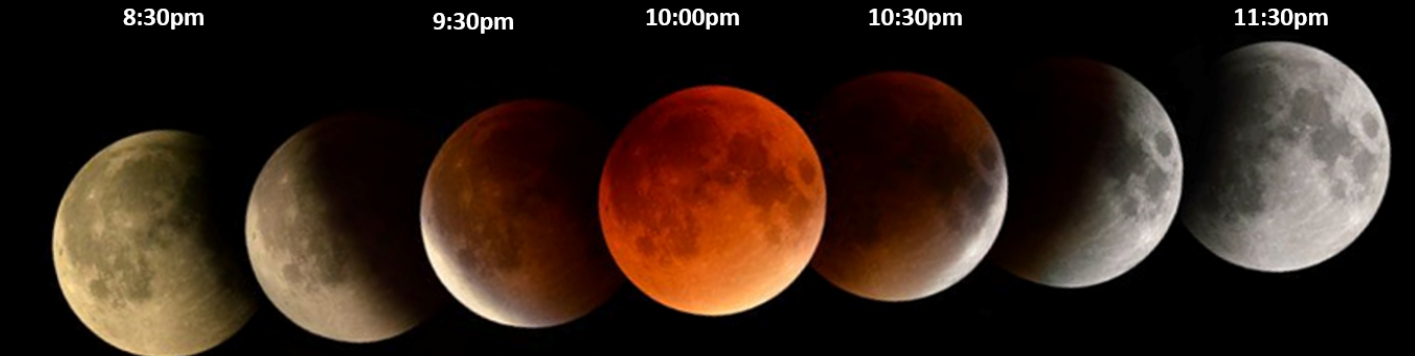
A total Eclipse of the Moon occurs on the evening of March 3. The Full Moon rises in the north-east at 7:42pm, just as the Sun is setting in the west. Whilst still in twilight, at 8:20pm, the Moon begins to enter the Earth’s shadow. Within minutes, the limb of the Moon starts to darken. The shadow marches across the face of the Moon, until 9:34pm, when the Moon enters the umbra, the darkest part of the shadow. We now have a Blood Moon. The depth of colour will be governed by the sunsets and sunrises around the world. The stars that would normally have been hidden in the bright moonlight sparkle in the darkened sky. The Milky Way is now clearly seen overhead. It takes the Moon 1 hour to travel through the umbra. At 10:32pm, the sky begins to brighten again. The changing appearance of the Moon during eclipse is shown below. All times are in ACDT, please adjust to your local time zone.