A guide to what's up in the sky for Southern Australia
Starwatch for October 2026 - Sat 3rd Oct 2026
Published 3rd Oct 2026
Astronauts, looking out of the space station windows at night, see great clusters of lights; the glow of hundreds of thousands of individual lights that mark cities on earth.
M15—Globular Cluster in Pegasus - Fri 2nd Oct 2026
Published 2nd Oct 2026
Messier 15 or M15 is a globular cluster in the constellation Pegasus. It was included in Charles Messier's catalogue of comet-like objects in 1764
Starwatch for September 2026 - Mon 7th Sep 2026
Published 7th Sep 2026
Spring is just around the corner, and with it, comes the promise of warmer evenings and clearer skies. And hopefully the opportunity to spend more time looking up!
Globular Cluster NGC 104 - Sun 6th Sep 2026
Published 6th Sep 2026
Globular Cluster NGC 104 - Located in the far southern constellation of Tucana
Starwatch for August 2026 - Sun 2nd Aug 2026
Published 2nd Aug 2026
The mid-winter Milky Way is still high overhead, and stars like Vega, Altair and Fomalhaut help to light the way on these cold nights. They will soon give way to the spring stars and constellations. Like our Sun, these stars are what astronomers refer to as Population I stars. Let’s explain that.
Colliding Galaxies in Ara - Sat 1st Aug 2026
Published 1st Aug 2026
ESO138-29 - Colliding Galaxies in Ara Right Ascension: 17:29:12 Declination: -62:27:35
Starwatch for July 2026 - Sat 27th Jun 2026
Published 27th Jun 2026
The centre of our galaxy, the Milky Way, is directly overhead during these cold winter evenings, and it is here, that we find one of the most prominent constellations.
M57—The Ring Nebula in Lyra - Fri 26th Jun 2026
Published 26th Jun 2026
The Ring Nebula, M57, is a planetary nebula in the northern constellation of Lyra
Starwatch for June 2026 - Mon 1st Jun 2026
Published 1st Jun 2026
The winter Milky Way shines across the sky from east to west in a blaze of starlight.
The Lagoon Nebula - Sat 30th May 2026
Published 30th May 2026
Image—The VLT Survey Telescope at ESO's Paranal Observatory in Chile
Starwatch for May 2026 - Sat 2nd May 2026
Published 2nd May 2026
The dominant constellation in our evening sky during autumn and winter is Scorpius, currently shining brightly in the eastern sky. Its brightest star, Antares, is a huge star of gargantuan proportions.
M83 - Spiral Galaxy in Hydra - Fri 1st May 2026
Published 1st May 2026
Messier 83 or M83 is a barred spiral galaxy approximately 15 million light-years away in the constellation borders of Hydra and Centaurus.
Starwatch for April 2026 - Tue 31st Mar 2026
Published 31st Mar 2026
As you venture out these crisp autumn evenings for a look at the night sky, bid a fond farewell to our starry companions over summer, and welcome the stars that will become our friends during the frosty winter evenings ahead. Stars with names like Arcturus, Antares, Spica, and Regulus.
NGC 1566 - Mon 30th Mar 2026
Published 30th Mar 2026
Spiral Galaxy in Dorado NGC 1566 is a spiral galaxy in the southern constellation of Dorado, the swordfish. It was discovered on May 28, 1826, by Scottish astronomer James Dunlop, observing from Paramatta Observatory in New South Wales. At 10th magnitude, it requires a telescope to view it.
Starwatch for March 2026 - Fri 27th Feb 2026
Published 27th Feb 2026
It seems just like yesterday that we greeted the return of the summer stars to the evening sky, and here we are in March, getting ready to wave goodbye!!
M44—The Beehive Cluster - Wed 25th Feb 2026
Published 25th Feb 2026
The Beehive Cluster is an open cluster in the constellation Cancer.
Starwatch for February 2026 - Mon 2nd Feb 2026
Published 2nd Feb 2026
During these warm February evenings, the summer Milky Way is visible directly overhead, running north-south across the sky. The evening sky is resplendent with many brilliant stars. From Capella in the north to the Pointers in the south, the sky is a sheer delight to explore.
NGC 2439—Open Star Cluster - Sun 1st Feb 2026
Published 1st Feb 2026
NGC 2439—Open Star Cluster - Distance: 12,500 light years
Starwatch for January 2026 - Tue 30th Dec 2025
Published 30th Dec 2025
We can think of our location in the universe along the lines of an address. The street would be planet Earth, the local government area would be the solar system, and the country would be the Milky Way Galaxy.
M1 - the Crab Nebula - Mon 29th Dec 2025
Published 29th Dec 2025
Distance: 6,500 light years
Starwatch for December 2025 - Tue 25th Nov 2025
Published 25th Nov 2025
All the stars we see in the night sky belong to our Milky Way galaxy. However, there are some objects outside of the Milky Way galaxy that can be seen quite clearly with no or little optical power.
Starwatch for November 2025 - Wed 29th Oct 2025
Published 29th Oct 2025
A 101 years ago, on November 23, 1924, the universe got larger.
Starwatch for October 2025 - Thu 2nd Oct 2025
Published 2nd Oct 2025
Astronomical distances can be mind boggling. Our closest neighbour, the Moon, is 380,000 kms away — equal to about 10 trips around Earth’s equator.
Starwatch for September 2025 - Wed 3rd Sep 2025
Published 3rd Sep 2025
A few lingering stars of winter are still in view during the evening. Antares, Altair, Vega have lit up the cold winter nights for us. But there is really only one bright star that puts in its best showing during these early spring nights:
NGC 7293 – The Helix Nebula - Tue 2nd Sep 2025
Published 2nd Sep 2025
Image © Patrick Cosgrove. The Helix Nebula, also known as NGC 7293, is a planetary nebula (PN) located in the constellation Aquarius.
Starwatch for August 2025 - Sun 3rd Aug 2025
Published 3rd Aug 2025
Imagine yourself sitting on a rock on the dark side of Moon, gazing up at the Milky Way. There's no stray lights, no atmosphere to dull your view of the night sky. The stars are so brilliant, so big, you could reach out and touch them.
NGC 4755 - Fri 1st Aug 2025
Published 1st Aug 2025
The Jewel Box Star Cluster. Image © Sergio Equivar, Buenos Aires, Argentina
Starwatch for July 2025 - Thu 3rd Jul 2025
Published 3rd Jul 2025
Look up overhead on any of these frosty winter’s nights, and if you have a dark area away from direct lighting, you’ll see the Milky Way shining brightly.
Galaxy NGC 6744 in Pavo - Wed 2nd Jul 2025
Published 2nd Jul 2025
This is NGC 6744, a spiral galaxy bearing similarities to our home galaxy, the Milky Way.
Starwatch for June 2025 - Mon 2nd Jun 2025
Published 2nd Jun 2025
The winter Milky Way shines across the sky from east to west in a blaze of starlight.
Eta Carinae Nebula (NGC 3372) - Sun 1st Jun 2025
Published 1st Jun 2025
Eta Carinae Nebula (NGC 3372) Distance: 7500 Light Years
Starwatch for May 2025 - Wed 30th Apr 2025
Published 30th Apr 2025
We have recently seen the destructive power of extreme weather events, such as cyclones and the flooding in southwest Queensland. It left in its wake flooded businesses, broken roads, power outages, and other problems. The repair bill will run into billions of dollars.
NGC 5139 - Omega Centauri - Tue 29th Apr 2025
Published 29th Apr 2025
Globular Cluster in Centaurus
Starwatch for April 2025 - Wed 2nd Apr 2025
Published 2nd Apr 2025
The crisp autumn evenings of April offer an ideal opportunity to explore the majesty of the southern sky. Go find yourself a nice dark spot in the back-garden, and let your eyes become accustomed to the darkness. Notice how many more stars you can see, even after a few minutes, as the pupils of your eyes expand to let as much light in as possible.
IC434 -The Horsehead Nebula - Tue 1st Apr 2025
Published 1st Apr 2025
Distance: 1500 Light Years |Constellation - Orion
Starwatch - March 2025 - Mon 3rd Mar 2025
Published 3rd Mar 2025
There's nothing more magical than to lie down on your back lawn on a warm summer evening and gaze up at the brilliant night sky.
Eta Carinae Nebula (NGC 3372) - Sat 1st Mar 2025
Published 1st Mar 2025
Distance: 7500 Light Years
Starwatch - February 2025 - Wed 5th Feb 2025
Published 5th Feb 2025
Two bright beacons hold centre stage in our night sky during February. In the beautiful pastel hues of an Australian summer sunset.
M104 - The Sombrero Galaxy - Tue 4th Feb 2025
Published 4th Feb 2025
Distance: 31 Million Light Years
Starwatch - January 2025 - Wed 1st Jan 2025
Published 1st Jan 2025
There's nothing more magical than to lie down on your back lawn on a warm summer evening and gaze up at the brilliant night sky.
The Pleiades star cluster - Tue 31st Dec 2024
Published 31st Dec 2024
The Pleiades star cluster (The Seven Sisters) Distance: 435 Light Years
Starwatch - December 2024 - Sun 1st Dec 2024
Published 1st Dec 2024
The stars that shine at night do so from immense distances.
Starwatch - November 2024 - Mon 4th Nov 2024
Published 4th Nov 2024
We recently saw the destructive power of hurricanes Milton and Helene, as they cut a path of destruction through various states in the US. They left in their wake flooded businesses, broken roads, power outages, and other problems. The repair bill will run into billions of dollars.
Large Magellanic Cloud - Fri 1st Nov 2024
Published 1st Nov 2024
Distance: 163,000 light years Right Ascension 05 : 23.6 Declination -69 : 45
Starwatch - October 2024 - Mon 30th Sep 2024
Published 30th Sep 2024
After a spectacular encounter with Pluto back in July 2015, the New Horizons spacecraft was redirected to visit a more distant object, known as 2014 MU69.
OCTOBER’S DEEP SKY HIGHLIGHT - Sun 29th Sep 2024
Published 29th Sep 2024
M31—The Andromeda Galaxy Distance: 2.5 million Light Years
Starwatch - September 2024 - Sat 31st Aug 2024
Published 31st Aug 2024
Spring is just around the corner, and with it, comes the promise of warmer evenings and clearer skies. And hopefully the opportunity to spend more time looking up!
NGC 253 – Galaxy in Sculptor - Fri 30th Aug 2024
Published 30th Aug 2024
NGC 253 is the brightest member of the Sculptor Group of galaxies.
Starwatch - August 2024 - Tue 30th Jul 2024
Published 30th Jul 2024
f you're brave enough to venture outside these cold winter nights, you'll be greeted by the heart of our Milky Way galaxy directly overhead. Find yourself a dark space in your backyard on a clear moonless night, and look straight up.
The Swan Nebula - Mon 29th Jul 2024
Published 29th Jul 2024
M17 – The Swan Nebula in Sagittarius
Starwatch July 2024 - Mon 8th Jul 2024
Published 8th Jul 2024
Look up overhead on any of these frosty winter’s nights, and as long as you have a dark area away from direct lighting, you’ll see the band of the Milky Way shining brightly.
Merging Galaxies - Sun 7th Jul 2024
Published 7th Jul 2024
NGC 4038-4039 Merging Galaxies - The Antennae. Distance: 45 million Light Years.
Starwatch June 2024 - Sun 2nd Jun 2024
Published 2nd Jun 2024
About half-way up the northern evening sky, a bright star shines.
The Trifid Nebula - Sat 1st Jun 2024
Published 1st Jun 2024
M20 – The Trifid Nebula in Sagittarius
Starwatch May 2024 - Thu 2nd May 2024
Published 2nd May 2024
A myriad of bright stars adorn the late autumn evening sky.
Galaxy NGC 5128 - Wed 1st May 2024
Published 1st May 2024
Galaxy NGC 5128—Centaurus A
Comet Pons-Brooks - Wed 10th Apr 2024
Published 10th Apr 2024
Looking west on the evening of April 27., 30 minutes after sunset. Locate the orange star Aldebaran, then scan to the left until you come to a fuzzy spot in the sky. Train your binoculars on it, the comet will be 239 million kilometres away. Graphic generated with Stellarium planetarium software.
M104 - The Sombrero Galaxy - Tue 9th Apr 2024
Published 9th Apr 2024
M104 - The Sombrero Galaxy. Distance: 31 Million Light Years
Starwatch - April 2024 - Mon 8th Apr 2024
Published 9th Apr 2024
Some of the brightest stars in the whole sky can be seen during these crisp autumn evenings.
Starwatch - March 2024 - Wed 6th Mar 2024
Published 6th Mar 2024
What a wonderful time of the year this is to be observing the night sky. The weather is warm, the nights clear, and the Milky Way shines directly overhead!
Object of the Month - Mon 4th Mar 2024
Published 4th Mar 2024
Eta Carinae Nebula (NGC 3372)
Distance: 7500 Light Years
Right Ascension: 10 : 43.8 | Declination: -59 : 52
Spring is just around the corner, and with it, comes the promise of warmer evenings and clearer skies. And hopefully the opportunity to spend more time looking up!
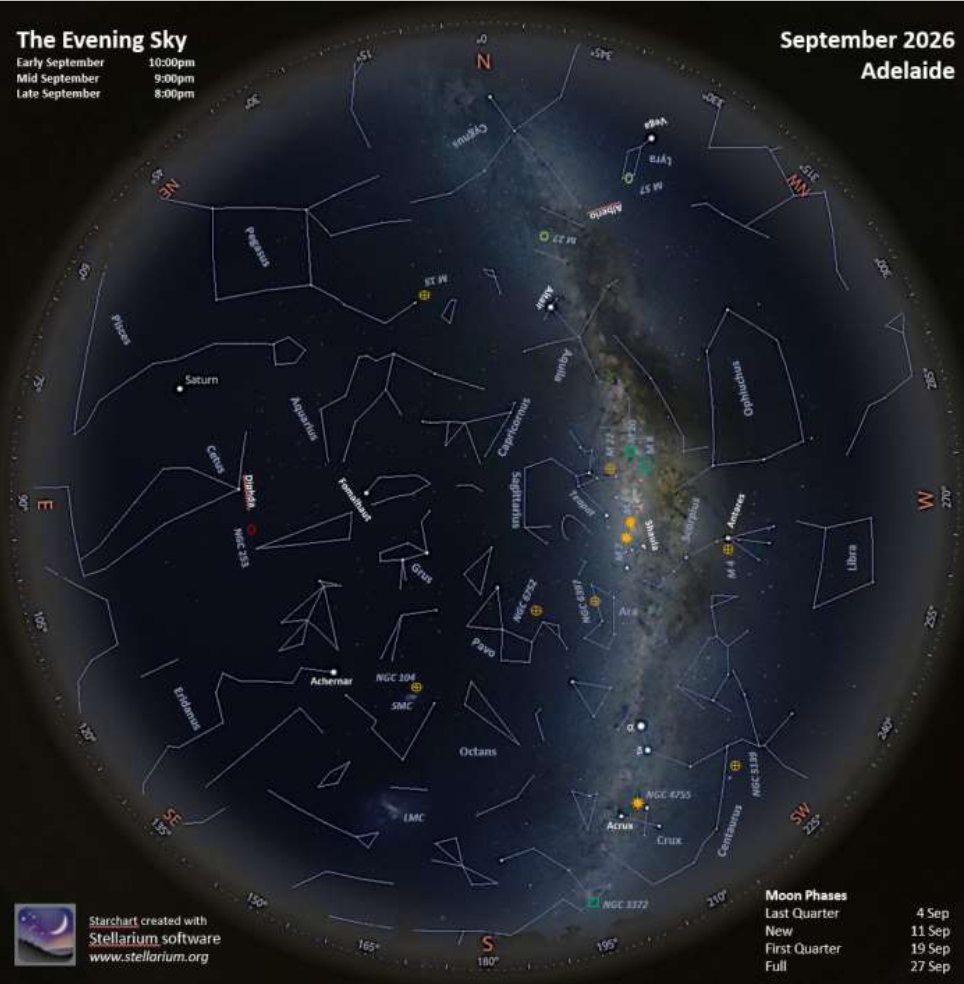
All 12 constellations of the zodiac are well known. But thanks to a popular '60s song, the most famous is Aquarius, the water-bearer. You can find it high in the eastern sky. Try looking for the stars of Aquarius on a dark night, as moonlight will overpower many of the constellation's fainter stars, but the brightest ones will still shine through.
Almost all major ancient civilizations saw Aquarius as a man or boy carrying a bucket of water. People have always placed special significance on Aquarius and the other constellations of the zodiac because they lie along the ecliptic; the path that the Sun follows through our sky.
In fact, that's what "the age of Aquarius" is all about. About 600 years from now, the Sun will appear in Aquarius at the time of the March equinox. But that's about the only significance for Aquarius and the other zodiacal constellations; they're good guideposts to help mark the seasons. They have no special influence over our daily lives.
Look up in the early evening, and you'll be greeted by the heart of our Milky Way galaxy almost directly overhead. You'll see the unmistakable form of Scorpius, the Scorpion, and the group of stars that make up the constellation of Sagittarius, the Archer. Look carefully in this area of the sky and you'll notice the misty glow of the countless millions of stars that are too far away for us to see clearly. Their light has journeyed for more than thirty thousand years to reach us.
As you scan the Milky Way, you’ll notice vast rifts that don’t seem to contain any stars. These rifts are actually enormous clouds of gas and dust that hide the Milky Way’s stars behind them. It’s not that there are no stars, they are just hidden from our view. The giant clouds of gas and dust will one day condense and form new stars.
Look low to the north. A beautiful blue-white star awaits. Vega is one of the closest and brightest stars in the night sky. It was one of the first stars whose distance was measured. The measurement has been refined since the 1800’s, and today astronomers know the distance quite precisely: 25 light-years. That means the light we see from Vega today left the star in 2001.
Look to the right of Vega and locate the stars that make up the constellation of Cygnus, the Swan. This star grouping has been identified with some sort of bird by most civilizations of the ancient world. Sometimes known as an eagle, a hen or a pigeon; the image of a graceful swan in full flight is the one I prefer. The star Deneb represents the tail of the swan, whilst Alberio is the beak.
In real life, Deneb is a star of enormous proportions. It is over 60,000 more luminous than our Sun, and 25 times more massive. If we placed our Sun at the same distance that Deneb is from us (1600 light years), then the Sun would be an insignificant little star barely visible in large amateur telescopes.
Alberio is a beautiful double star of blue and gold. A steadily held pair of powerful binoculars should show it as two distinct stars.
Higher in the sky we find Aquila, the Eagle. The brightest star in this constellation is Altair. At a distance from us of only 16 light years, it definitely classifies as a close stellar neighbour. But a bit of a strange character! It is about twice the diameter of our Sun, but spins on its axis in 6 and a half hours (our Sun takes 25 days). As a matter of fact, the spin is so rapid, that the star probably resembles a flattened tomato!
You might expect our closest neighbouring star to be one of the brightest lights in the night sky. Instead, though, it’s so faint that it wasn’t discovered until over a century ago, in September 1915. Now known as Proxima Centauri, it’s just four-and-a-quarter light-years away.
If all the stars were as bright as the Sun, nearby stars would be easy to find, because they’d shine the brightest. But most stars are red dwarfs, which are so faint that not a single one is visible to the unaided eye.
Proxima Centauri was discovered by Robert Innes. He was born in Scotland but journeyed to South Africa to observe the southern sky. He made his great find by examining photographic plates taken on two different nights; one in 1910 and the other in 1915. Innes alternated the view from one plate to the other. In this way, he spotted a dim star that shifted position during the five-year interval, a sign the star was close by.
The new star was quite close to Alpha Centauri, which was the closest-known star system. What’s more, the new star seemed to be moving in the same direction as Alpha Centauri, which suggested they might be related. Sure enough, when astronomers measured it, they found it was nearly the same distance as Alpha Centauri.
It turns out that the star is actually a member of the Alpha Centauri system. But it’s a bit closer to us than the system’s other two stars, hence its name: Proxima Centauri, the closest star to the Sun.
Proxima Centauri has three known or candidate planets orbiting it. These worlds are the closest known exoplanets to our solar system. Proxima Centauri b is a rocky, Earth-sized planet with a mass similar to Earth. It orbits inside the star's habitable zone, but heavy solar flares from the star make it hard to know if it can hold an atmosphere or water. Proxima Centauri c is a larger candidate planet that sits much farther out, though its exact existence is still debated by scientists. Proxima Centauri d is a very small planet weighing about a quarter of Earth's mass. It hugs very close to the star and completes an orbit in just five days.
Let’s return closer to home. Building the planets of the solar system was like building a city, it didn’t happen all at once. Instead, it probably took a hundred million years or more to complete the construction project.
The first to be completed were Jupiter and Saturn, the Sun’s largest planets. They came together in the prime real estate for planet building – the region with the most raw materials. Closer to the Sun, it was so hot that ices were vaporized and blown away. Farther from the Sun, the material thinned out. But at the distance of Jupiter and Saturn, the balance was just right.
The two giants took shape in a hurry. Small grains of ice and rock stuck together to make pebbles, then baseball-sized chunks, then boulders, and so on. That quickly built massive cores, which then swept up huge amounts of leftover hydrogen and helium gas. So, within just a few million years, Jupiter and Saturn grew to monstrous proportions.
Saturn consists of a series of layers. Its core is a dense ball of metal and rock. Around that is a layer of hydrogen that’s squeezed so tightly that it forms a metal. Around that is a layer of liquid hydrogen – the lightest and simplest chemical element. And the planet is topped by an atmosphere that contains methane, ammonia, water, and other compounds.
Despite its great size, Saturn spins once every 10.7 hours. That pushes material outward, making the planet fatter through the equator. The combination of its composition and rotation makes Saturn especially light, it’s less dense than water. If we could find a bath large enough, we could float Saturn in it.
Stargazers have been eagerly awaiting Saturn’s return to the evening skies to get a view of its magnificent rings. You can find it low in the eastern sky between the constellations of Pisces and Cetus. The planet's rings were first observed by Galileo Galilei soon after the invention of the telescope in 1609. While the other three Jovian planets (Jupiter, Uranus and Neptune) have since been discovered to have rings, they’re faint and no match for the magnificent system around Saturn. Since crossing the planet’s ring plane in March 2025, we now get a view of their southern side. This aspect will continue as the rings gradually open up until the next passage of the Earth through the ring plane in 2038.
The Moon is at Last Quarter on September 4, at New on the 11th, at First Quarter on the 19th, and Full on September 27th.