A guide to what's up in the sky for Southern Australia
Starwatch for November 2026 - Tue 3rd Nov 2026
Published 3rd Nov 2026
“How far can you see?” is one of the most common questions I get asked when showing someone the night sky.
Large Magellanic Cloud - Mon 2nd Nov 2026
Published 2nd Nov 2026
The Magellanic Clouds are named for the explorer Ferdinand Magellan who noted their presence in 1519.
Starwatch for October 2026 - Sat 3rd Oct 2026
Published 3rd Oct 2026
Astronauts, looking out of the space station windows at night, see great clusters of lights; the glow of hundreds of thousands of individual lights that mark cities on earth.
M15—Globular Cluster in Pegasus - Fri 2nd Oct 2026
Published 2nd Oct 2026
Messier 15 or M15 is a globular cluster in the constellation Pegasus. It was included in Charles Messier's catalogue of comet-like objects in 1764
Starwatch for September 2026 - Mon 7th Sep 2026
Published 7th Sep 2026
Spring is just around the corner, and with it, comes the promise of warmer evenings and clearer skies. And hopefully the opportunity to spend more time looking up!
Globular Cluster NGC 104 - Sun 6th Sep 2026
Published 6th Sep 2026
Globular Cluster NGC 104 - Located in the far southern constellation of Tucana
Starwatch for August 2026 - Sun 2nd Aug 2026
Published 2nd Aug 2026
The mid-winter Milky Way is still high overhead, and stars like Vega, Altair and Fomalhaut help to light the way on these cold nights. They will soon give way to the spring stars and constellations. Like our Sun, these stars are what astronomers refer to as Population I stars. Let’s explain that.
Colliding Galaxies in Ara - Sat 1st Aug 2026
Published 1st Aug 2026
ESO138-29 - Colliding Galaxies in Ara Right Ascension: 17:29:12 Declination: -62:27:35
Starwatch for July 2026 - Sat 27th Jun 2026
Published 27th Jun 2026
The centre of our galaxy, the Milky Way, is directly overhead during these cold winter evenings, and it is here, that we find one of the most prominent constellations.
M57—The Ring Nebula in Lyra - Fri 26th Jun 2026
Published 26th Jun 2026
The Ring Nebula, M57, is a planetary nebula in the northern constellation of Lyra
Starwatch for June 2026 - Mon 1st Jun 2026
Published 1st Jun 2026
The winter Milky Way shines across the sky from east to west in a blaze of starlight.
The Lagoon Nebula - Sat 30th May 2026
Published 30th May 2026
Image—The VLT Survey Telescope at ESO's Paranal Observatory in Chile
Starwatch for May 2026 - Sat 2nd May 2026
Published 2nd May 2026
The dominant constellation in our evening sky during autumn and winter is Scorpius, currently shining brightly in the eastern sky. Its brightest star, Antares, is a huge star of gargantuan proportions.
M83 - Spiral Galaxy in Hydra - Fri 1st May 2026
Published 1st May 2026
Messier 83 or M83 is a barred spiral galaxy approximately 15 million light-years away in the constellation borders of Hydra and Centaurus.
Starwatch for April 2026 - Tue 31st Mar 2026
Published 31st Mar 2026
As you venture out these crisp autumn evenings for a look at the night sky, bid a fond farewell to our starry companions over summer, and welcome the stars that will become our friends during the frosty winter evenings ahead. Stars with names like Arcturus, Antares, Spica, and Regulus.
NGC 1566 - Mon 30th Mar 2026
Published 30th Mar 2026
Spiral Galaxy in Dorado NGC 1566 is a spiral galaxy in the southern constellation of Dorado, the swordfish. It was discovered on May 28, 1826, by Scottish astronomer James Dunlop, observing from Paramatta Observatory in New South Wales. At 10th magnitude, it requires a telescope to view it.
Starwatch for March 2026 - Fri 27th Feb 2026
Published 27th Feb 2026
It seems just like yesterday that we greeted the return of the summer stars to the evening sky, and here we are in March, getting ready to wave goodbye!!
M44—The Beehive Cluster - Wed 25th Feb 2026
Published 25th Feb 2026
The Beehive Cluster is an open cluster in the constellation Cancer.
Starwatch for February 2026 - Mon 2nd Feb 2026
Published 2nd Feb 2026
During these warm February evenings, the summer Milky Way is visible directly overhead, running north-south across the sky. The evening sky is resplendent with many brilliant stars. From Capella in the north to the Pointers in the south, the sky is a sheer delight to explore.
NGC 2439—Open Star Cluster - Sun 1st Feb 2026
Published 1st Feb 2026
NGC 2439—Open Star Cluster - Distance: 12,500 light years
Starwatch for January 2026 - Tue 30th Dec 2025
Published 30th Dec 2025
We can think of our location in the universe along the lines of an address. The street would be planet Earth, the local government area would be the solar system, and the country would be the Milky Way Galaxy.
M1 - the Crab Nebula - Mon 29th Dec 2025
Published 29th Dec 2025
Distance: 6,500 light years
Starwatch for December 2025 - Tue 25th Nov 2025
Published 25th Nov 2025
All the stars we see in the night sky belong to our Milky Way galaxy. However, there are some objects outside of the Milky Way galaxy that can be seen quite clearly with no or little optical power.
Starwatch for November 2025 - Wed 29th Oct 2025
Published 29th Oct 2025
A 101 years ago, on November 23, 1924, the universe got larger.
Starwatch for October 2025 - Thu 2nd Oct 2025
Published 2nd Oct 2025
Astronomical distances can be mind boggling. Our closest neighbour, the Moon, is 380,000 kms away — equal to about 10 trips around Earth’s equator.
Starwatch for September 2025 - Wed 3rd Sep 2025
Published 3rd Sep 2025
A few lingering stars of winter are still in view during the evening. Antares, Altair, Vega have lit up the cold winter nights for us. But there is really only one bright star that puts in its best showing during these early spring nights:
NGC 7293 – The Helix Nebula - Tue 2nd Sep 2025
Published 2nd Sep 2025
Image © Patrick Cosgrove. The Helix Nebula, also known as NGC 7293, is a planetary nebula (PN) located in the constellation Aquarius.
Starwatch for August 2025 - Sun 3rd Aug 2025
Published 3rd Aug 2025
Imagine yourself sitting on a rock on the dark side of Moon, gazing up at the Milky Way. There's no stray lights, no atmosphere to dull your view of the night sky. The stars are so brilliant, so big, you could reach out and touch them.
NGC 4755 - Fri 1st Aug 2025
Published 1st Aug 2025
The Jewel Box Star Cluster. Image © Sergio Equivar, Buenos Aires, Argentina
Starwatch for July 2025 - Thu 3rd Jul 2025
Published 3rd Jul 2025
Look up overhead on any of these frosty winter’s nights, and if you have a dark area away from direct lighting, you’ll see the Milky Way shining brightly.
Galaxy NGC 6744 in Pavo - Wed 2nd Jul 2025
Published 2nd Jul 2025
This is NGC 6744, a spiral galaxy bearing similarities to our home galaxy, the Milky Way.
Starwatch for June 2025 - Mon 2nd Jun 2025
Published 2nd Jun 2025
The winter Milky Way shines across the sky from east to west in a blaze of starlight.
Eta Carinae Nebula (NGC 3372) - Sun 1st Jun 2025
Published 1st Jun 2025
Eta Carinae Nebula (NGC 3372) Distance: 7500 Light Years
Starwatch for May 2025 - Wed 30th Apr 2025
Published 30th Apr 2025
We have recently seen the destructive power of extreme weather events, such as cyclones and the flooding in southwest Queensland. It left in its wake flooded businesses, broken roads, power outages, and other problems. The repair bill will run into billions of dollars.
NGC 5139 - Omega Centauri - Tue 29th Apr 2025
Published 29th Apr 2025
Globular Cluster in Centaurus
Starwatch for April 2025 - Wed 2nd Apr 2025
Published 2nd Apr 2025
The crisp autumn evenings of April offer an ideal opportunity to explore the majesty of the southern sky. Go find yourself a nice dark spot in the back-garden, and let your eyes become accustomed to the darkness. Notice how many more stars you can see, even after a few minutes, as the pupils of your eyes expand to let as much light in as possible.
IC434 -The Horsehead Nebula - Tue 1st Apr 2025
Published 1st Apr 2025
Distance: 1500 Light Years |Constellation - Orion
Starwatch - March 2025 - Mon 3rd Mar 2025
Published 3rd Mar 2025
There's nothing more magical than to lie down on your back lawn on a warm summer evening and gaze up at the brilliant night sky.
Eta Carinae Nebula (NGC 3372) - Sat 1st Mar 2025
Published 1st Mar 2025
Distance: 7500 Light Years
Starwatch - February 2025 - Wed 5th Feb 2025
Published 5th Feb 2025
Two bright beacons hold centre stage in our night sky during February. In the beautiful pastel hues of an Australian summer sunset.
M104 - The Sombrero Galaxy - Tue 4th Feb 2025
Published 4th Feb 2025
Distance: 31 Million Light Years
Starwatch - January 2025 - Wed 1st Jan 2025
Published 1st Jan 2025
There's nothing more magical than to lie down on your back lawn on a warm summer evening and gaze up at the brilliant night sky.
The Pleiades star cluster - Tue 31st Dec 2024
Published 31st Dec 2024
The Pleiades star cluster (The Seven Sisters) Distance: 435 Light Years
Starwatch - December 2024 - Sun 1st Dec 2024
Published 1st Dec 2024
The stars that shine at night do so from immense distances.
Starwatch - November 2024 - Mon 4th Nov 2024
Published 4th Nov 2024
We recently saw the destructive power of hurricanes Milton and Helene, as they cut a path of destruction through various states in the US. They left in their wake flooded businesses, broken roads, power outages, and other problems. The repair bill will run into billions of dollars.
Large Magellanic Cloud - Fri 1st Nov 2024
Published 1st Nov 2024
Distance: 163,000 light years Right Ascension 05 : 23.6 Declination -69 : 45
Starwatch - October 2024 - Mon 30th Sep 2024
Published 30th Sep 2024
After a spectacular encounter with Pluto back in July 2015, the New Horizons spacecraft was redirected to visit a more distant object, known as 2014 MU69.
OCTOBER’S DEEP SKY HIGHLIGHT - Sun 29th Sep 2024
Published 29th Sep 2024
M31—The Andromeda Galaxy Distance: 2.5 million Light Years
Starwatch - September 2024 - Sat 31st Aug 2024
Published 31st Aug 2024
Spring is just around the corner, and with it, comes the promise of warmer evenings and clearer skies. And hopefully the opportunity to spend more time looking up!
NGC 253 – Galaxy in Sculptor - Fri 30th Aug 2024
Published 30th Aug 2024
NGC 253 is the brightest member of the Sculptor Group of galaxies.
Starwatch - August 2024 - Tue 30th Jul 2024
Published 30th Jul 2024
f you're brave enough to venture outside these cold winter nights, you'll be greeted by the heart of our Milky Way galaxy directly overhead. Find yourself a dark space in your backyard on a clear moonless night, and look straight up.
The Swan Nebula - Mon 29th Jul 2024
Published 29th Jul 2024
M17 – The Swan Nebula in Sagittarius
Starwatch July 2024 - Mon 8th Jul 2024
Published 8th Jul 2024
Look up overhead on any of these frosty winter’s nights, and as long as you have a dark area away from direct lighting, you’ll see the band of the Milky Way shining brightly.
Merging Galaxies - Sun 7th Jul 2024
Published 7th Jul 2024
NGC 4038-4039 Merging Galaxies - The Antennae. Distance: 45 million Light Years.
Starwatch June 2024 - Sun 2nd Jun 2024
Published 2nd Jun 2024
About half-way up the northern evening sky, a bright star shines.
The Trifid Nebula - Sat 1st Jun 2024
Published 1st Jun 2024
M20 – The Trifid Nebula in Sagittarius
Starwatch May 2024 - Thu 2nd May 2024
Published 2nd May 2024
A myriad of bright stars adorn the late autumn evening sky.
Galaxy NGC 5128 - Wed 1st May 2024
Published 1st May 2024
Galaxy NGC 5128—Centaurus A
Comet Pons-Brooks - Wed 10th Apr 2024
Published 10th Apr 2024
Looking west on the evening of April 27., 30 minutes after sunset. Locate the orange star Aldebaran, then scan to the left until you come to a fuzzy spot in the sky. Train your binoculars on it, the comet will be 239 million kilometres away. Graphic generated with Stellarium planetarium software.
M104 - The Sombrero Galaxy - Tue 9th Apr 2024
Published 9th Apr 2024
M104 - The Sombrero Galaxy. Distance: 31 Million Light Years
Starwatch - April 2024 - Mon 8th Apr 2024
Published 9th Apr 2024
Some of the brightest stars in the whole sky can be seen during these crisp autumn evenings.
Starwatch - March 2024 - Wed 6th Mar 2024
Published 6th Mar 2024
What a wonderful time of the year this is to be observing the night sky. The weather is warm, the nights clear, and the Milky Way shines directly overhead!
Object of the Month - Mon 4th Mar 2024
Published 4th Mar 2024
Eta Carinae Nebula (NGC 3372)
Distance: 7500 Light Years
Right Ascension: 10 : 43.8 | Declination: -59 : 52
“How far can you see?” is one of the most common questions I get asked when showing someone the night sky.
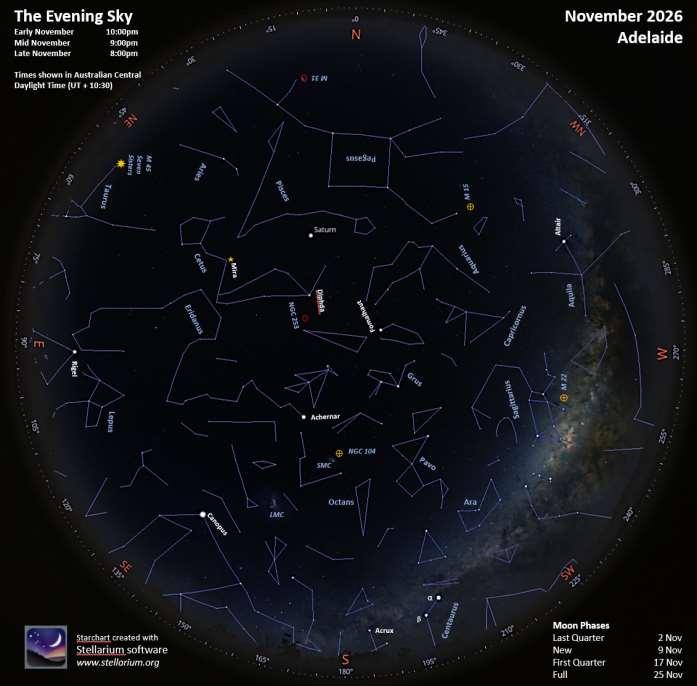
And during November, we are perfectly placed to answer this question. The Great Andromeda Galaxy (M31), located low in the northern sky is the farthest object we can see with the naked eye. It is the closest of the large galaxies and contains approximately two hundred billion stars, about as many as our own galaxy. You can see it as a faint smudge of light away from city lights.
The light from the Andromeda Galaxy takes over 2 and a half million years to complete its journey to the earth. Just think about that. The light from the Andromeda Galaxy had already been travelling for a million years before the very first hominids roamed across the plains of east Africa.
By the time the very first ancestors of modern man started making stone tools in China and Africa, the light had completed over 85% of its journey. Travelling at 300,000 kilometres per second, the light raced across intergalactic space to the Milky Way galaxy. When the slaves of Egypt built the great pyramids 5000 years ago, the light from Andromeda was already well inside our own galaxy.
Almost 2800 years ago, Chinese astronomers observed an eclipse of the Sun. They would have also known of that little smudge of light in the night sky but would have been totally unaware of what it represented.
The Greek and Roman empires rose and crumbled; Christopher Columbus discovered the West Indies; and Galileo pointed his first telescope to the heavens. Still that light travelled. By the time Neil Armstrong walked on the Moon in 1969, only 57 years remained of its journey.
The other fun fact to remember is that the Andromeda Galaxy is getting closer to us, by about 400,000 kilometres every hour!
For more than a decade, in fact, it looked like the two galaxies were on a collision course. But recent studies say there’s only a 50-50 chance of a collision and merger. And if it does happen, it’ll take place billions of years later than previous estimates.
The new study used years of observations by two space telescopes – Hubble and Gaia. Researchers plugged those observations into simulations that also considered the gravitational effects of two smaller galaxies. The results indicated that one of them tends to push Andromeda and the Milky Way together, while the other tends to pull them apart.
The researchers ran a hundred thousand simulations. In half of them, Andromeda and the Milky Way flew past each other and went their own ways. In the other half, they eventually spiralled together and merged – but not for at least 10 billion years – twice as long as earlier estimates.
The simulations aren’t the final word, as there are just too many uncertainties. But for now, it seems likely that the two giants will stay apart for a long, long time. Phew!!! That’s a relief. I hated the new name that that been proposed for the combined galaxy – Milkomeda!!
So, when you next go out on a clear November night and look at that smudge of light that we know as the Andromeda Galaxy, try to imagine that immense journey and all the history that has passed since that light began its journey to Earth.
Rising in the east late into the evening, we can now see the constellations that will keep us company during the warm summer nights. Orion, the mighty hunter of Greek legends is the best known. Stars like Sirius, Rigel, Betelguese and Aldebaran bring a formidable brilliance to the eastern sky which is not repeated at any other time of the year.
Another sign of the coming of summer is the appearance of the Pleiades star cluster in the north-eastern sky. Probably better known by its more common name of “the Seven Sisters”, the cluster marks the shoulder of Taurus, the bull.
The Pleiades is actually a cluster of several hundred young stars. It's about 400 light-years from Earth. If we were orbiting a star embedded in the Pleiades, and looking back toward our own solar system, the Sun would be invisible. It's just too faint to see from that far away. But many of the stars of the Pleiades are hotter and brighter than the Sun, so they're easy to see.
Long-exposure photographs of the cluster show that the stars are surrounded by wisps of gas. The gas shows up because it reflects light from the stars.
Astronomers used to think this gas was left over from the formation of the cluster. But over the last decade or so, they've come to realize that the stars are just passing through the gas cloud, so there's no real relationship between them.
Look high in the northern sky and you’ll find beautiful Saturn. It’s height above the horizon means that atmospheric turbulence will be at a minimum ensuring crisp views of the planet and its magnificent rings.
It’s pretty easy to measure the length of a day on Mars or most other solid bodies. Just pick a feature on the surface and see how long it takes to spin back into view. That’s not the case for Saturn though. It’s not so easy for planets that don’t have a solid surface. We can track bands of clouds, but different bands can move at different speeds.
Scientists have been trying to pin down Saturn’s rotation rate, the length of its day, for centuries. When the twin Voyager spacecraft flew past Saturn in the 1980s, they measured the planet’s magnetic field to reveal the rotation rate of its interior. But when the Cassini spacecraft orbited Saturn decades later, its observations showed the day was about six minutes longer.
At the end of its mission, Cassini flew between Saturn and the inner edge of its rings. Measuring waves in the rings and tiny changes in the planet’s gravitation field produced yet another length: 10 hours, 33 minutes, and 38 seconds.
One thing you’ll notice when observing Saturn, if you can bear to move your gaze away from the rings, is that the ball looks flattened at the poles. It is 10 percent wider through its equator than through the poles. A result of its low density and fast rotation.
Saturn consists of a series of layers. Its core is a dense ball of metal and rock. Around that is a layer of hydrogen that’s squeezed so tightly that it forms a metal. Around that is a layer of liquid hydrogen, the lightest and simplest chemical element. And the planet is topped by an atmosphere that contains methane, ammonia, water, and other compounds.
Saturn doesn’t have a solid surface. But scientists have defined a “surface” as the depth in its atmosphere where the pressure equals the surface pressure on Earth. At that level, Saturn’s gravity is only a bit stronger than Earth’s gravity. If you were floating at that altitude, you’d feel like you’d added a few kilograms. And because of Saturn’s flattened shape, you’d feel heavier at the poles than the equator.
The Moon is at Last Quarter on November 2, New on the 9th, at First Quarter on the 17th, and Full on the 25th.
Happy stargazing.